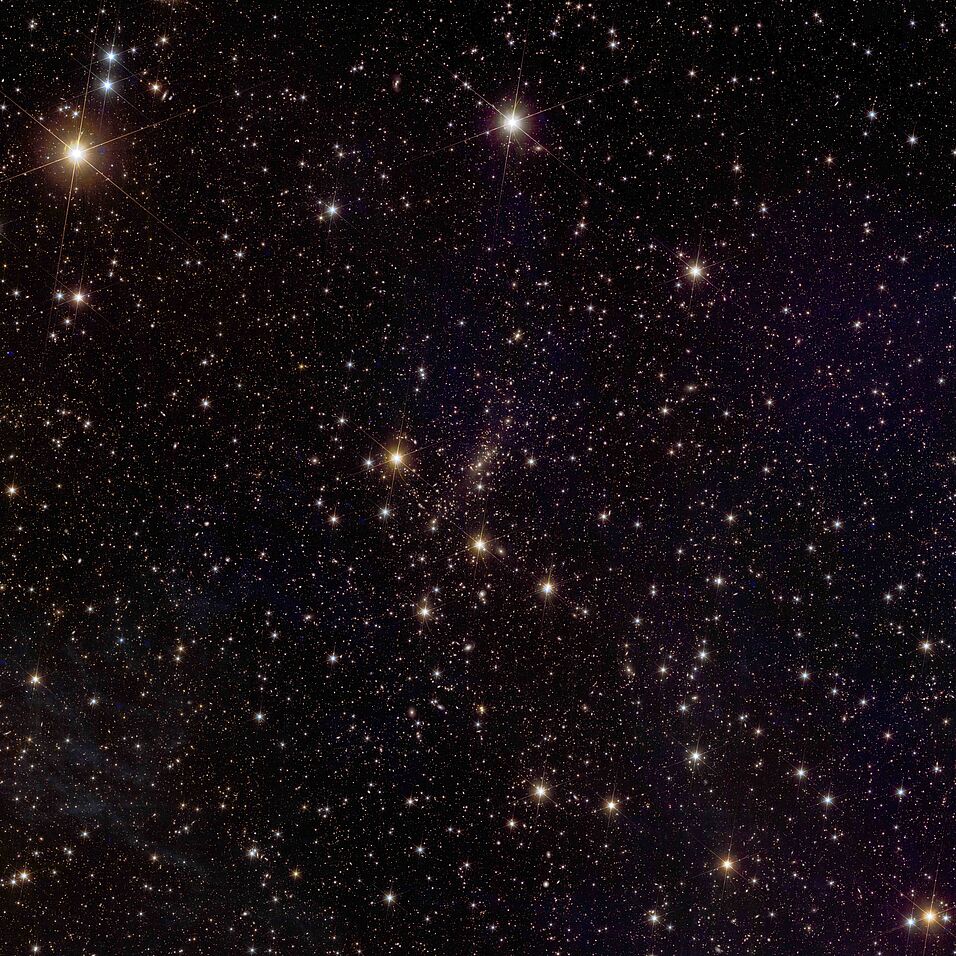
One of DUNE's central goals is to learn more about dark matter and dark energy in the universe. Together, these invisible components make up 95% of the universe's energy content, yet their respective physical nature remains largely unknown. Neither dark matter nor dark energy can be directly observed. Indirectly, however, they leave signatures—for example, in the distributions and properties of galaxies, as well as in minute distortions of observed galaxy shapes caused by gravitational lensing. Comparing galaxy observations with theoretical models can thus shed light on the dark universe.
DUNE uses observational data from two new space telescopes: The European Space Agency's (ESA) Euclid mission, launched in July 2023, is expected to deliver razor-sharp images of more than one-third of the night sky by the end of the decade. The James Webb Space Telescope (JWST), a joint project of the European (ESA), American (NASA), and Canadian (CSA) space agencies, allows scientists to peer deep into the universe's past in small regions of the sky.
As part of international research collaborations, the DUNE team analyzes Euclid data at the University of Innsbruck and JWST observational data at ISTA. To draw conclusions about the properties of dark matter and dark energy, the observational results are compared with simulated "virtual universes." These simulations are co-developed at the University of Vienna and model cosmic structure formation in these digital replicas of our universe. COLIBRE is a simulation project featuring a small number of particularly detailed simulations. Complementary to this are simulations from the DISCO project, which can rapidly test many different theories using MUSICA, Austria's new supercomputer.
DUNE opens a new window to the dark universe for Austria and brings us one step closer to answering the greatest questions of modern cosmology.